
Christmas is a magical time, but we know it can also be very busy. Here we guide you through some baby sensory activities that are super easy to do at home. They’re also very soothing for babies who can become overwhelmed with all the Christmas music, lights and chatter and might need some time out.
All you need is you and your baby! We always say you are your baby’s best toy. And at Christmas, there are also often lots of items on hand at home that can be included in baby sensory activities.
What is baby sensory play?
Baby sensory activities engage our children’s senses – their vision, touch, scent, hearing and taste – to help with their development, communication and learning. This might be through:
- creative play
- massage
- tummy time
- movement
Baby sensory activities are simple, easy to repeat at home, and very soothing.
The benefits of baby sensory
Playing with your baby and doing sensory activities helps your baby to be happier and healthier. These kinds of activities increase feelings of warmth and safety for your baby, and build your relationship and attachment.
Sensory activities help to develop baby’s brain by building connections within it. They also help to lay the foundations for future learning. This type of play can also help your baby to explore and understand their environment, and start to strengthen their muscles and improve their coordination.
When your baby is ready to play
Babies give you strong cues when they’re engaged and ready to play. These include:
- babbling
- gazing into your face
- smiling
- moving their arms and legs
- looking at you with bright eyes
- making an ooh sound with their lips.
This is useful when you’re doing sensory activities as it tells you they’re enjoying it. It’s also a good way of noticing if they’re enjoying playing with other family members and friends.
Your baby might need some alone time if they’re:
- crying
- arching their back
- fussing
- turning their head away
- pulling or pushing
- whining
- closing their eyes
- frowning.
How can I give my baby alone time if we’re doing sensory activities together?
You might be able to relate to the feeling of not being tired, but just needing to get away from everybody else and have a bit of time alone. This is often particularly true after a busy day, or if you’ve been surrounded by other people. Babies are the same, but the big difference is that they aren’t born with the knowledge they’re a separate entity from their parents. Their sense of self doesn’t develop until 15-24 months.
This means it’s perfectly possible for your baby to get some “alone” time with you there, as you’re an extension of them. That’s why you might hear parents say: “I can’t put them down… They want to be on me all the time.” When you think about it in this way it makes sense.
Shouldn’t I just let my baby sleep?
Yes, you should let your baby sleep if that’s what they want. If your baby does want to sleep, they’ll let you know by closing their eyes, yawning, or looking sleepy. But sometimes children can need downtime without sleep, especially at busy times like Christmas.
Baby sensory activities to try at home
The best activities for baby sensory are those that encourage babies to use one or more of their senses, and where parent and baby have eye contact or communicate with each other in some way. Here are some examples:
Christmas crinkles
A great activity to do with your baby is to explore something shiny and crinkly together, like Christmas tinsel. You can also use foil or a sensory blanket for this, or anything that’s both shiny and crinkly.
The best way to do this safely is to hold it yourself and show it to them, or gently touch it on the back of their hand. As you crinkle the tinsel, they will look at it and how it catches the light and listen to the crinkling sound. Supervise your baby carefully if they touch or hold the tinsel, as they might want to put it in their mouth. Tinsel often has wire inside it and the individual strands can fall off too, so don’t leave them with tinsel unsupervised.
Exploring together with lots of encouraging sounds, talk, and eye contact will naturally engage your baby. And discovering this joy together is an amazing way to build the connection between you and your child.

Christmas lights
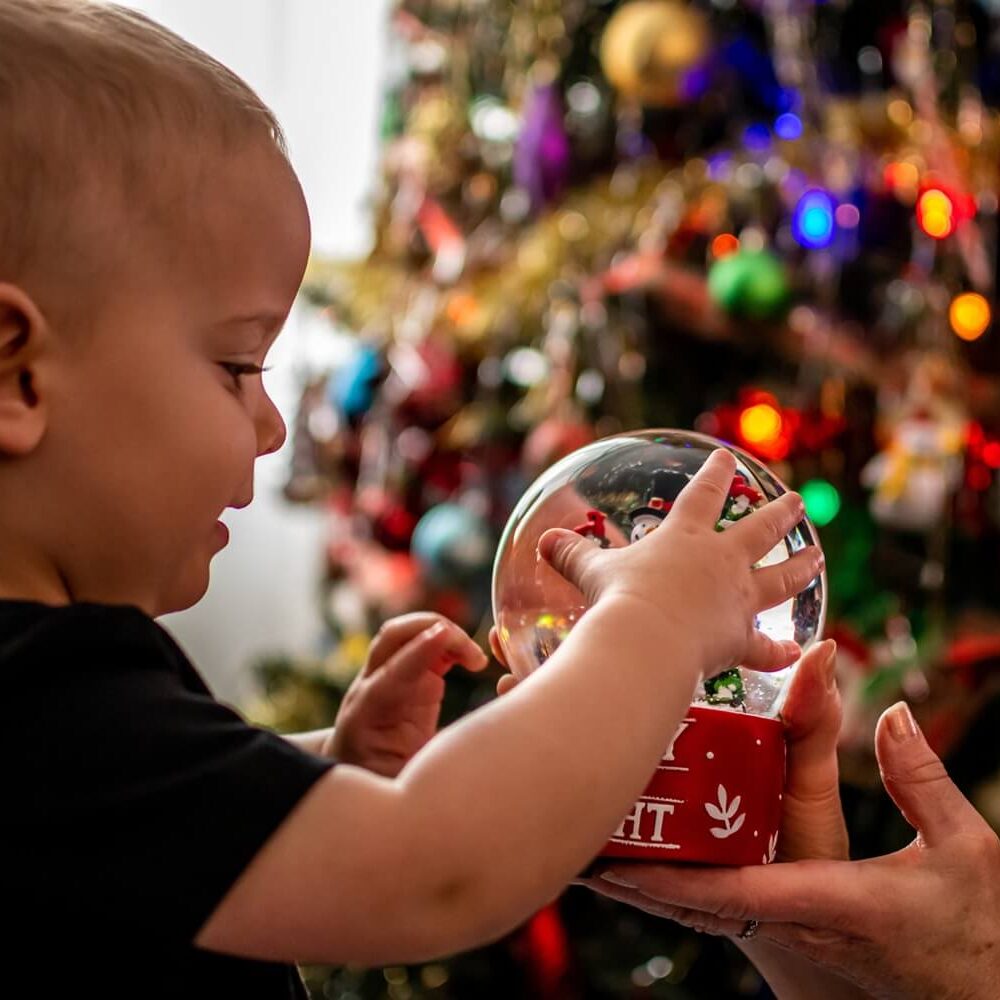
Looking at Christmas lights is another great sensory activity to do with your baby. Sit with your baby out of reach of the lights and where they’re not too bright, and prepare to snuggle up and bond as you enjoy the soothing lights and patterns.
Lots of Christmas lights twinkle. Besides being enjoyable to watch, they can help with the development of the rods and cones at the back of the eyes. And watching lights that flash in sequence can also encourage them to develop their visual tracking ability – it’s the same thing GPs test for when they get children to track their finger.
You could also put a small string of battery operated lights inside a clear plastic screw top container (these are widely available for storing craft materials and food). You can add small bits of tinsel, bells and plastic baubles to make a sensory shaker. If your child is a toddler, you’ll need to seal the lid, but for babies the screw top is ideal and makes it easy for you to switch the lights on and off.
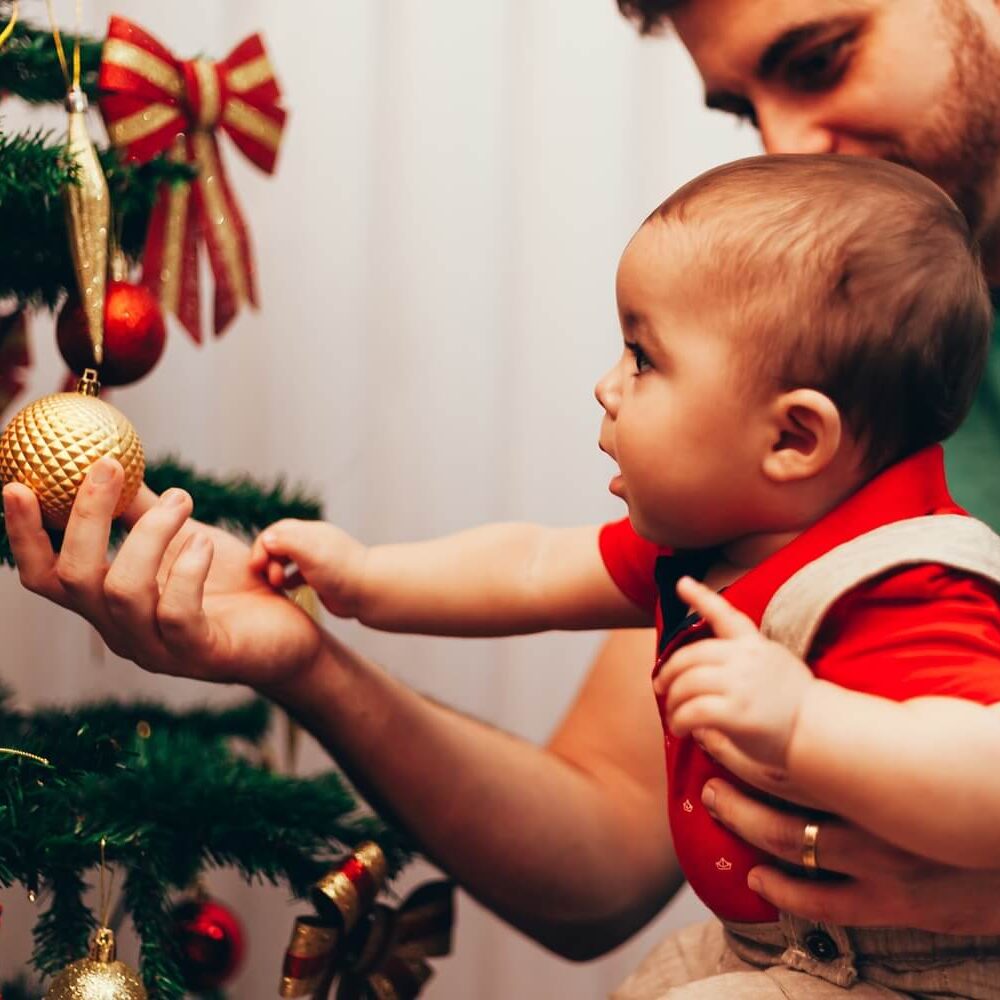
Something else you could use that’s reflective is a shiny, plastic Christmas tree bauble (the kind that has a plastic loop to hang it up, instead of wire). Make sure baubles are 5cm or bigger so they aren’t a choking hazard if your child puts it to their mouth.
As with looking at tinsel, use plenty of encouraging sounds and words to help build a connection with your baby.
Jingling bells
Jingling bells are a Christmas essential, which is excellent as they’re very common in baby sensory. They give off a nice, well-rounded sound that’s not too loud, so this works best if your child is in a quiet room where the bells are the loudest sound they can hear. Bells are also very versatile – they can be used to get your baby to sleep, or if they’re feeling active and playful, they can take the lead.
Children can reach out and grasp from as early as four months. If you’re using a toy with a jingle or rattle that’s intended for babies to hold they can take it and make the sound themselves. You can then pass the baby toy between you in what we call “serve and return” interactions, where you pass the toy to them when they indicate they’d like it. This mirroring builds the foundation of later communications. It’s also important for bonding, as you’re saying: “If you ask for me, I’ll be here for you”.
As with looking at lights, moving the bells around will encourage them to track the sound as it moves, which will come in handy later when they’re following sound and conversations. If they’re also lying on their back or tummy the neck movement can also help develop gross motor skills.

Baby massage
Baby massage is a huge part of baby sensory since touch is a powerful way to communicate real love. For the specifics on how to do baby massage, see this NCT guide – but it’s the touch that matters.
It’s great for physical development, encouraging them to stretch their arms and contract them again. It can also help with things like digestion, and it can help relieve reflux or colic.
There’s no real Christmas element to this part, but it’s probably one of the best ways going to relax your baby after the hustle and bustle of the communal living room.
Peekaboo with Christmas wrapping paper
“Serve and return”, which we first mentioned in the Jingling bells section, is also a key part of “peekaboo”. This is possibly the most underrated of all simple children’s games. As well as all that lovely interactivity we mentioned above, it also helps your baby understand that you’re there even when eye contact is temporarily removed. This helps with their sense of security and can help reassure them when parents leave them to sleep.
Baby sensory classes might use coloured scarves that are slightly see-through which parents hold over their faces to do peekaboo. Of course, Christmas wrapping will work just fine for this too… Bonus points if you can actually get a present wrapped while doing it! Bear in mind older babies will want to scrunch the paper up and put it in their mouth, so supervise them carefully if they’re playing with paper.
Final thoughts
Christmas is a busy time, but as you can see from our ideas, there are lots of ways to play sensory games with your baby with things that you’ll probably have around your house. But whatever toys you have, all that really matters is that you’re there to spend time with your baby – after all, you’re the most important person to them.
Call, text, email or web chat FamilyLine
If you’re feeling overwhelmed, worried or upset about any aspect of your family life, FamilyLine is here for you. We offer free emotional support and guidance on family relationships, conflict, parenting, caring, financial worries and more.
Contact FamilyLine